How coloring can support your child's development
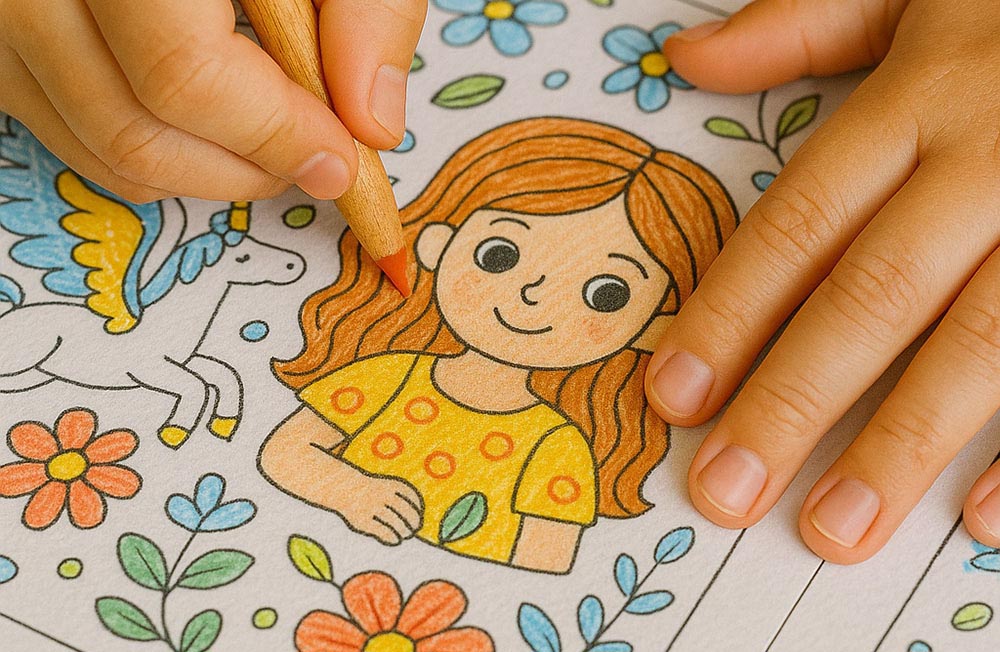
A sheet of paper, a few crayons, and a cat that’s going to be purple today. Coloring is a simple activity with plenty to offer: practice for little hands, space for ideas, and a quiet moment together. Offer it for the pleasure of creating, not to produce a perfect picture.
1. Practicing hand control and coordination
As children move a crayon across paper, they practice controlling their hands and matching their movements to what they see. Holding the page steady with the other hand also gets both hands working together. It’s an enjoyable way to become familiar with the kind of tool they’ll later use for writing. Mix coloring with drawing, modeling clay, and other hands-on play.1
2. An enjoyable way to focus
The roof first, or the windows? What color will the dragon be? A coloring page invites small decisions and attention to one activity. A picture that interests your child gives them a reason to notice details and work at their own pace. A few interested minutes are worth more than finishing under pressure. The rest can wait until tomorrow.
3. Room for imagination and exploring colors
A printed outline can be the beginning of a story. Let your child choose the colors, add a hat to a character, or imagine where they’re going. Along the way, you can name colors, compare shades, and look for shapes. “This blue is lighter” feels more natural than a quiz. Put a blank sheet beside the coloring page, too: free drawing offers even more room for their own ideas.2
4. A quiet break after a busy day
If your child enjoys crayons, coloring can help them slow down and do something pleasant. In a small study of pupils aged around 11, test anxiety fell after coloring.3 That’s an encouraging finding about how children felt at that moment. At home, offer coloring as a quiet activity when your child is in the mood for it.
5. The pleasure of creating and being together
“That was my idea!” Choosing colors and adding details gives children something of their own to feel proud of. Rather than judging whether it looks nice, notice their idea: “I see your dragon has rainbow wings. Will you tell me about it?” Your interest shows that what they create matters. You can color side by side, talk about a story, or simply enjoy being together.
How do you get started without pressure?
- Choose a picture that suits your child. Large, simple spaces make a good starting point; save tiny details for when they feel enjoyable.
- Let them go outside the lines. Especially for toddlers, scribbling is a natural part of exploring crayons, not a mistake to correct.
- Keep it comfortable and take breaks. Choose age-appropriate crayons that are easy to hold. When little hands get tired, put the page aside.
A coloring page doesn’t have to be finished for your time together to count. Exploring, trying things, and enjoying their own ideas are what matter.
Want to carry on an adventure from a favorite tale? In Super Stories, you’ll find stories and accompanying coloring pages to keep the play going.
Sources and further reading
-
Whittington Health NHS Trust, Handwriting and Recording Ideas (guidance on drawing, coloring, and learning to write). ↩
-
ZERO TO THREE, Learning to Write and Draw (drawing development and supporting children’s creativity). ↩
-
Carsley, Heath, and Fajnerova (2015), Effectiveness of a Classroom Mindfulness Coloring Activity for Test Anxiety in Children, Journal of Applied School Psychology (abstract in ERIC). ↩